Skip to content
Skip to content
Workspace

Add blur, glow, shadows and color effects

Open Effects after selecting a layer. Add one effect at a time so you can tell what each change contributes. A subtle shadow can separate a card from its background; a glow can give a bright object a softer edge.
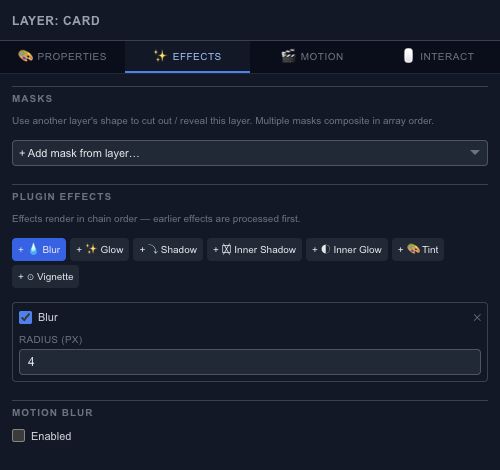
Blur added to the real Effects tab, with its radius control.

Available effects#

The tab offers Blur, Glow, Shadow, Inner Shadow, Inner Glow, Tint and Vignette. Each added effect exposes its own controls. Use its checkbox to compare the result with the effect bypassed, or remove it with the close button.

Effects run in chain order. Blurring a tinted shape and tinting an already blurred result can produce different edges. Review the composition after combining several effects instead of relying on the panel alone.

Motion blur#

Enable Motion Blur for a moving layer and compare frames where it is travelling fastest. Keep a sharp version for reference. Trail Count, Frame Interval, Max Opacity and Speed Threshold control the visible trail. Higher sampling or a longer blur can change both the look and rendering work, so inspect Resources if playback becomes less responsive.

Bake Motion Blur is marked as coming soon. Keep the editable settings as your working source.

Export support varies by output format. A still image and a vector export do not preserve every effect in the same way; check warnings in the export dialog and inspect the resulting file.

A good place to start
Getting started / Chorono documentationChorono documentationLearn Chorono with editable animation examples. Install the editor, edit keyframes, build loops and connect Claude Code or Codex through MCP. Cre…Getting started / Install ChoronoInstall ChoronoSet up the free, open-source animation editor on your computer and start a local browser session. This guide installs the browser editor, its loc…Getting started / Create your first editable animationCreate your first editable animationOpen an editable Chorono example, change its text and colors, inspect the timeline, then save and reopen your first 2D animation. Start with a re…Workspace / Chorono editor workspaceChorono editor workspaceFind the canvas, layers, properties, timeline and resource tools in the Chorono editor. Choose a guide for each part of your animation workflow.…Workspace / Canvas and drawing toolsCanvas and drawing toolsNavigate the canvas, draw shapes and splines, use snapping and edit motion keys in Chorono. Use the canvas to arrange the objects in your composi…Workspace / Choose a drawing or transform toolChoose a drawing or transform toolUse Select, Pan, Pen, Move, Rotate, Scale and Anchor tools without losing track of the active editing mode. Choose the tool that matches the edit…Workspace / Select exactly the objects you needSelect exactly the objects you needUse box, lasso, circle, paint and rule-based selection to work with several animation layers. When several objects overlap, clicking each one can…Workspace / Align objects with guides and snappingAlign objects with guides and snappingSet grid, object, point, guide, pixel, angle and scale snapping for precise placement in Chorono. Snapping helps a dragged object settle on an ex…Workspace / Edit Bézier points and spline curvesEdit Bézier points and spline curvesDraw editable paths, adjust points and handles, and extend or close a spline in Chorono. A curve is easier to control when you can see the points…Workspace / Edit animation positions on the canvasEdit animation positions on the canvasUse Motion Keys to adjust position keys, draw a movement and control how the path is timed. Motion Keys bring position editing onto the canvas. T…Workspace / Layers and scene hierarchyLayers and scene hierarchySelect, name, group and organize scene objects in Chorono using the Layers panel and Scene Explorer. A layer is an editable object in your Choron…Workspace / Draw and edit basic shapesDraw and edit basic shapesCreate rectangles, circles, polygons and procedural shapes, then adjust their geometry in Properties. Basic shapes are a useful starting point fo…
Explore the docs